
Aang (![[personal profile]](https://www.dreamwidth.org/img/silk/identity/user.png) actually112) wrote2015-05-17 09:12 pm
actually112) wrote2015-05-17 09:12 pm
actually112) wrote2015-05-17 09:12 pm


Entry tags:
Draft of Aang's Expose
[First, there is darkness. Then, the voice of an old man begins to speak.
“Fire is the element of power. The people of the Fire Nation have desire and will and the energy and drive to achieve what they want.”
There is an image of a brilliant, beautiful city, covered in shades of red and gold and brown; if one’s familiar with it, then one can accurately identify it as something not unlike the cities of Imperial Japan. In city squares, people dance, and fire blasts from their fingertips as naturally as air from their lungs.
“Earth is the element of substance. The people of the Earth Kingdom are diverse and strong. They are persistent and enduring.”
There is the image of people working in mines and fields, their heads bowed with large reed caps on their heads to block out the sun. When they stomp the ground, it trembles and rocks spit up and throw themselves according to their will. An astute observer could see that their clothes and architecture are not unlike that of pre-modern China.
“Air is the element of freedom. The Air Nomads detached themselves from worldly concerns and found peace and freedom. Also, they apparently had pretty good senses of humor.”
There are people wearing long, flowing orange robes, floating on clouds of air they summon themselves and plucking fruit from trees. The images flip between those of men with shaved heads and arrows tattooed across their body and those of women with only shaved foreheads and arrows tattooed across their body doing the work. As they go, they talk and they practically float, feet never seeming to meet the ground for long. For them, laughter and work and floating seem to be constant and beautiful. If one compares them to anything from other worlds, they could be called Tibetan.
“Water is the element of change. The people of the Water Tribe are capable of adapting to many things. They have a deep sense of community and love that holds them together through anything.”
There are packs of people wandering across a frozen tundra, making their way to water with fishing equipment. Some of them simply move, and water comes from the ocean in little tendrils, wavering with their will and bringing them fish and food to eat. If they look like any people from other worlds, they look Inuit.
“All this four elements talk is sounding like Avatar stuff.” Now, it’s the voice of a teenage boy. A teenage boy that some people may remember—Zuko.
“Yes. It is the combination of the four elements in one person that makes the Avatar so powerful,” the old man’s voice answers.
Suddenly, a familiar voice of a Capitol-accented announcer comes on.]
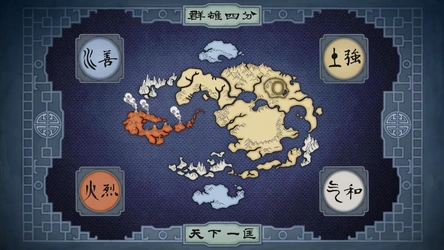
In this world, there are four nations divided according to element. [A stylized map fades into view. Those who can understand classical Chinese characters will be able to read that on the top and bottom of the map is a couplet that reads ‘Powers are divided into four, the world is guided by one’.] The Fire Nation, the Water Tribes, the Earth Kingdom, and the Air Temples. Four people, four countries, all living in harmony under one person: the Avatar. And did you know we have an Avatar here with us as a tribute?
[A recording of Aang in the 11th arena, throwing paper airplanes through the mall.] You’ve seen him at play.
[A recording of Aang and Zuko both fighting against Feferi in the 11th arena.] You’ve seen him work.
[A recording of Aang holding hands with Clementine at school.] You’ve even seen him fall in love.
[A pause for the expected ‘aww’ response.]
Aang of District 4, the inspiration of trendy arrow tattoos and a thief of the Capitol’s heart. You all know him, you all love him, but did you know he was the force of harmony in his world? Hard to believe, isn’t it?
[The screen fades to black.]
Many long years ago, before recorded history, there was a spirit of light and harmony named Raava and a spirit of darkness and chaos named Vaatu. For tens of thousands of years, Raava and Vaatu fought until a human, in a fit of misguided compassion, freed them from their constant battle, and in doing so, freed Vaatu. The human, determined to fix its mistake, joined Raava in fighting and finally imprisoning Vaatu. The human and Raava fused together to create a new being to protect the world and the balance that it depends on. This new creature, neither human nor spirit, is the Avatar.
Aang is the Avatar, the newest life in a line that goes back thousands of lifetimes. He was born to the Air Nomads, a primitive but peaceful people who lived in the mountains.
[The camera shows Aang (sans tattoos) with many other boys his age, and they all literally jump off the edge of a cliff while holding gliders. Each one of them, instead of plummeting to their deaths, take gracefully to the sky until they look like orange birds.]
But the Fire Nation wanted to colonize the world to spread their poisonous anti-establishment culture. Their one threat was the Avatar, but the Air Nomads refused to share his identity—they would only reveal him at the traditional age of sixteen.
Yet, seeing that threats to the Avatar’s life loomed, and seeing that he earned his airbending mastery and the arrows that symbolized it at the unheard-of age of eleven, they chose to tell the Avatar of his identity four years early.
[An image of Aang, sitting in front of a group of monks, looking stricken and pale. “How do you know it’s me?”
As they explain that they knew because he chose the only four Avatar artifacts in a room of thousands of toys when he was five, he fidgets with his hands, trying to distract himself by fiddling with the toys that they put in front of him.
“Normally, we would have told you of your identity when you turned sixteen, but there are troubling signs. Storm clouds are gathering.”
“I fear that war may be upon us, young Avatar.”
“We need you, Aang.”
Aang bows his head, his hands stilling in his lap.]
The Avatar wasn’t ready to learn he had the responsibility of the world on his shoulders. He fled.
[The camera shows Aang flying on a giant six-legged bison with arrows on its fur, yelling and struggling to steer as they go through a massive storm over the ocean before a tidal wave catches them and draws them into the water.
They both seem unconscious, but as they fall deeper into the water, Aang’s tattoos begin to glow and he opens his eyes, revealing that they’re glowing as well, and his expression twists into one of rage before he slams his fists together. Ice grows out from him, freezing him and the bison safe in a giant iceberg.]
As he slept beneath the ocean, a great comet that only comes once every century, Sozin’s Comet, arrived. It gave the firebenders immeasurable power. They used it to launch an attack on the Air Nomads.
[The camera shows men in metal armor and tanks marching on all the temples. Many monks and nuns refuse to take up arms, and instead stand in their way, allowing themselves to be burned so that the others may have time to escape. Those that do choose to fight are terrors to behold—stealing breath from soldiers’ lungs, using wind like a horrible knife to cut through metal and flesh and bone, picking up debris from the ground with powerful gusts and using it to tear bodies apart—but ultimately, they are not trained to kill, and they die. The last to go are children, who all struggle to slip away and fly, only to be burned by blasts of fire three hundred feet tall.]
Between the attacks on the temples, bounties on the heads of airbenders, and systematic killings, all but one Air Nomad was dead within a decade. The last airbender, the only one the Fire Nation really wanted to kill, stayed in ice. He stayed there for a hundred years while war raged.
[The camera lingers over the fighting inherent in war. It shows waterbenders freezing the eyes of firebenders in their sockets. Fire sweeping through entire forests. Spikes of earth rising from the ground and turning a fertile field into a craggy trench land. A young girl screaming because her hair has turned into a mane of fire. It shows black snow falling on a burning Water Tribe village and burn-disfigured bodies dangling impaled on spikes of stone.
Then one last shot—the empty Southern Air Temple, and Aang’s back as he faces an airbender skeleton surrounded by those of the Fire Nation. His knees buckle under him and he folds until his head is hidden in his arms, all without any sound.]
When he was awoken by two Southern Water Tribesmen by the names of Katara and Sokka, it was knowing that he had to take the world back from the Fire Nation by defeating the Fire Lord before summer’s end, when Sozin’s Comet would arrive again, and the only way to do this was to master all four elements.
[There’s a montage of Aang’s adventures with a waterbender girl—she can’t be older than fourteen—and a nonbending boy who can’t be more than fifteen or sixteen. While watching these adventures, it’s easy to see how the people have suffered, and have in some ways become complacent in their suffering. Bands of children orphaned by the war bomb dams and flood towns suspected of holding Fire Nation troops, some of the bombers being young as eight years old. People are forced to hide their bending or have their benders stolen at night with bags over their heads. Entire towns cower or sit idly when there are threats to them, instead asking for Aang’s help, which at various times ends up with him being thrown like a puppet by spirits as tall as buildings or standing in front of erupting volcanoes and blowing hard enough to stop the lava rolling into villages, which lets it form parts of a dome instead around the villages.
Interspersed in these adventures are people’s reactions to Aang—some of them shout abuse at them, accusing him of allowing the war to go on and turning his back on the world, and some of them keep their head bowed and speak to him in polite whispers. It becomes clear that he’s considered some kind of religious figure, and he accepts the brunt of the kind of feelings most people would reserve for deities.]
The Fire Nation hunted him tirelessly, because he was their greatest threat. They were correct to be afraid.
[There is the Northern Tribe, grand and beautiful and surrounded by a massive wall of ice, being attacked by an entire fleet of Fire Nation ships. Fire Nation tanks roll through the tribe and water and fire are being thrown everywhere. Suddenly, the full moon is gone, literally gone from the sky, and there’s only darkness. Then the water glows and a giant beast made only from ocean water rises from it, and its glow is bright enough to illuminate the night.
A close up shows that, in a tiny air pocket within the beast’s chest, Aang stands with glowing eyes, glowing tattoos, and an expression of incredible rage on his face as he puppets the beast from within.
Water Tribesmen immediately fall into a deep bow, pressing their foreheads to the ground as the beast walks through the tribe. They are spared. The firebenders who try to attack are killed by waves of water that crush them against walls or pulls them into canals. The ships attempt to move back from the shore, but the beast walks into the ocean, and it cuts through the metal of the ships and causes great waves to capsize them and anyone who falls into the ocean is swallowed by unnatural whirlpools.]
The power of the Avatar is so great, that one that had only experienced twelve years of life could join with the ocean spirit and kill over 100,000 people in less than an hour.
Avatar Aang was taught by Katara, the waterbender, Toph, the blind earthbender, and Zuko, the firebending Fire Prince defector, and through almost a year of adversity, they stood against the Fire Lord as the comet came and he was poised to destroy the Earth Kingdom as his grandfather had destroyed the Air Nomads.
[There’s another montage—first, it shows his teachers. Toph, a girl who can’t be older than twelve with thick milky cataracts on her eyes, taking out seven grown men just by sweeping the earth with her feet and moving it; then Zuko, a sixteen-year-old with a disfiguring facial scar, standing to face two giant dragons with Aang at his back.
Then it shows all the things that had to be faced. Corrupt political officials brainwashing innocent civilians. A fourteen-year-old girl that looks suspiciously like the victor Azula, blue fire and lightning coming from her fingers while she points at Aang. Another fourteen-year-old girl, dancing like she’s in the circus and paralyzing every limb she jabs. A sixteen-year-old, dressed in fancy clothes and throwing knives with deadly precision. An old woman who could bend the blood in a person’s veins. A tall, burly man with a metal arm, a metal leg, and an eye tattooed on his forehead that cracked and firebended bombs with a breath. A giant spirit like a centipede with an eyelid at its front, and every time it blinked, a new human face would appear there. Angry mobs, beasts, soldiers, children, and the war—until it all comes down to Aang sitting on a great stone pillar, watching the sky turn red and big airships raining walls of fire coming towards him.]
The warmongering Fire Nation is spared for now, because this is when we saved Avatar Aang to play for us all in the Hunger Games.
But we don’t want to deprive our fans of seeing evil people get their just desserts. We have exclusive footage of what would have happened to the Fire Lord if we had been less generous, and what still will happen if the Avatar has anything to say about it.
[It plays a video without any commentary.
]
Warmongers will always see that they can never win.
Good luck in the Hunger Games, Avatar Aang!
“Fire is the element of power. The people of the Fire Nation have desire and will and the energy and drive to achieve what they want.”
There is an image of a brilliant, beautiful city, covered in shades of red and gold and brown; if one’s familiar with it, then one can accurately identify it as something not unlike the cities of Imperial Japan. In city squares, people dance, and fire blasts from their fingertips as naturally as air from their lungs.
“Earth is the element of substance. The people of the Earth Kingdom are diverse and strong. They are persistent and enduring.”
There is the image of people working in mines and fields, their heads bowed with large reed caps on their heads to block out the sun. When they stomp the ground, it trembles and rocks spit up and throw themselves according to their will. An astute observer could see that their clothes and architecture are not unlike that of pre-modern China.
“Air is the element of freedom. The Air Nomads detached themselves from worldly concerns and found peace and freedom. Also, they apparently had pretty good senses of humor.”
There are people wearing long, flowing orange robes, floating on clouds of air they summon themselves and plucking fruit from trees. The images flip between those of men with shaved heads and arrows tattooed across their body and those of women with only shaved foreheads and arrows tattooed across their body doing the work. As they go, they talk and they practically float, feet never seeming to meet the ground for long. For them, laughter and work and floating seem to be constant and beautiful. If one compares them to anything from other worlds, they could be called Tibetan.
“Water is the element of change. The people of the Water Tribe are capable of adapting to many things. They have a deep sense of community and love that holds them together through anything.”
There are packs of people wandering across a frozen tundra, making their way to water with fishing equipment. Some of them simply move, and water comes from the ocean in little tendrils, wavering with their will and bringing them fish and food to eat. If they look like any people from other worlds, they look Inuit.
“All this four elements talk is sounding like Avatar stuff.” Now, it’s the voice of a teenage boy. A teenage boy that some people may remember—Zuko.
“Yes. It is the combination of the four elements in one person that makes the Avatar so powerful,” the old man’s voice answers.
Suddenly, a familiar voice of a Capitol-accented announcer comes on.]
In this world, there are four nations divided according to element. [A stylized map fades into view. Those who can understand classical Chinese characters will be able to read that on the top and bottom of the map is a couplet that reads ‘Powers are divided into four, the world is guided by one’.] The Fire Nation, the Water Tribes, the Earth Kingdom, and the Air Temples. Four people, four countries, all living in harmony under one person: the Avatar. And did you know we have an Avatar here with us as a tribute?
[A recording of Aang in the 11th arena, throwing paper airplanes through the mall.] You’ve seen him at play.
[A recording of Aang and Zuko both fighting against Feferi in the 11th arena.] You’ve seen him work.
[A recording of Aang holding hands with Clementine at school.] You’ve even seen him fall in love.
[A pause for the expected ‘aww’ response.]
Aang of District 4, the inspiration of trendy arrow tattoos and a thief of the Capitol’s heart. You all know him, you all love him, but did you know he was the force of harmony in his world? Hard to believe, isn’t it?
[The screen fades to black.]
Many long years ago, before recorded history, there was a spirit of light and harmony named Raava and a spirit of darkness and chaos named Vaatu. For tens of thousands of years, Raava and Vaatu fought until a human, in a fit of misguided compassion, freed them from their constant battle, and in doing so, freed Vaatu. The human, determined to fix its mistake, joined Raava in fighting and finally imprisoning Vaatu. The human and Raava fused together to create a new being to protect the world and the balance that it depends on. This new creature, neither human nor spirit, is the Avatar.
Aang is the Avatar, the newest life in a line that goes back thousands of lifetimes. He was born to the Air Nomads, a primitive but peaceful people who lived in the mountains.
[The camera shows Aang (sans tattoos) with many other boys his age, and they all literally jump off the edge of a cliff while holding gliders. Each one of them, instead of plummeting to their deaths, take gracefully to the sky until they look like orange birds.]
But the Fire Nation wanted to colonize the world to spread their poisonous anti-establishment culture. Their one threat was the Avatar, but the Air Nomads refused to share his identity—they would only reveal him at the traditional age of sixteen.
Yet, seeing that threats to the Avatar’s life loomed, and seeing that he earned his airbending mastery and the arrows that symbolized it at the unheard-of age of eleven, they chose to tell the Avatar of his identity four years early.
[An image of Aang, sitting in front of a group of monks, looking stricken and pale. “How do you know it’s me?”
As they explain that they knew because he chose the only four Avatar artifacts in a room of thousands of toys when he was five, he fidgets with his hands, trying to distract himself by fiddling with the toys that they put in front of him.
“Normally, we would have told you of your identity when you turned sixteen, but there are troubling signs. Storm clouds are gathering.”
“I fear that war may be upon us, young Avatar.”
“We need you, Aang.”
Aang bows his head, his hands stilling in his lap.]
The Avatar wasn’t ready to learn he had the responsibility of the world on his shoulders. He fled.
[The camera shows Aang flying on a giant six-legged bison with arrows on its fur, yelling and struggling to steer as they go through a massive storm over the ocean before a tidal wave catches them and draws them into the water.
They both seem unconscious, but as they fall deeper into the water, Aang’s tattoos begin to glow and he opens his eyes, revealing that they’re glowing as well, and his expression twists into one of rage before he slams his fists together. Ice grows out from him, freezing him and the bison safe in a giant iceberg.]
As he slept beneath the ocean, a great comet that only comes once every century, Sozin’s Comet, arrived. It gave the firebenders immeasurable power. They used it to launch an attack on the Air Nomads.
[The camera shows men in metal armor and tanks marching on all the temples. Many monks and nuns refuse to take up arms, and instead stand in their way, allowing themselves to be burned so that the others may have time to escape. Those that do choose to fight are terrors to behold—stealing breath from soldiers’ lungs, using wind like a horrible knife to cut through metal and flesh and bone, picking up debris from the ground with powerful gusts and using it to tear bodies apart—but ultimately, they are not trained to kill, and they die. The last to go are children, who all struggle to slip away and fly, only to be burned by blasts of fire three hundred feet tall.]
Between the attacks on the temples, bounties on the heads of airbenders, and systematic killings, all but one Air Nomad was dead within a decade. The last airbender, the only one the Fire Nation really wanted to kill, stayed in ice. He stayed there for a hundred years while war raged.
[The camera lingers over the fighting inherent in war. It shows waterbenders freezing the eyes of firebenders in their sockets. Fire sweeping through entire forests. Spikes of earth rising from the ground and turning a fertile field into a craggy trench land. A young girl screaming because her hair has turned into a mane of fire. It shows black snow falling on a burning Water Tribe village and burn-disfigured bodies dangling impaled on spikes of stone.
Then one last shot—the empty Southern Air Temple, and Aang’s back as he faces an airbender skeleton surrounded by those of the Fire Nation. His knees buckle under him and he folds until his head is hidden in his arms, all without any sound.]
When he was awoken by two Southern Water Tribesmen by the names of Katara and Sokka, it was knowing that he had to take the world back from the Fire Nation by defeating the Fire Lord before summer’s end, when Sozin’s Comet would arrive again, and the only way to do this was to master all four elements.
[There’s a montage of Aang’s adventures with a waterbender girl—she can’t be older than fourteen—and a nonbending boy who can’t be more than fifteen or sixteen. While watching these adventures, it’s easy to see how the people have suffered, and have in some ways become complacent in their suffering. Bands of children orphaned by the war bomb dams and flood towns suspected of holding Fire Nation troops, some of the bombers being young as eight years old. People are forced to hide their bending or have their benders stolen at night with bags over their heads. Entire towns cower or sit idly when there are threats to them, instead asking for Aang’s help, which at various times ends up with him being thrown like a puppet by spirits as tall as buildings or standing in front of erupting volcanoes and blowing hard enough to stop the lava rolling into villages, which lets it form parts of a dome instead around the villages.
Interspersed in these adventures are people’s reactions to Aang—some of them shout abuse at them, accusing him of allowing the war to go on and turning his back on the world, and some of them keep their head bowed and speak to him in polite whispers. It becomes clear that he’s considered some kind of religious figure, and he accepts the brunt of the kind of feelings most people would reserve for deities.]
The Fire Nation hunted him tirelessly, because he was their greatest threat. They were correct to be afraid.
[There is the Northern Tribe, grand and beautiful and surrounded by a massive wall of ice, being attacked by an entire fleet of Fire Nation ships. Fire Nation tanks roll through the tribe and water and fire are being thrown everywhere. Suddenly, the full moon is gone, literally gone from the sky, and there’s only darkness. Then the water glows and a giant beast made only from ocean water rises from it, and its glow is bright enough to illuminate the night.
A close up shows that, in a tiny air pocket within the beast’s chest, Aang stands with glowing eyes, glowing tattoos, and an expression of incredible rage on his face as he puppets the beast from within.
Water Tribesmen immediately fall into a deep bow, pressing their foreheads to the ground as the beast walks through the tribe. They are spared. The firebenders who try to attack are killed by waves of water that crush them against walls or pulls them into canals. The ships attempt to move back from the shore, but the beast walks into the ocean, and it cuts through the metal of the ships and causes great waves to capsize them and anyone who falls into the ocean is swallowed by unnatural whirlpools.]
The power of the Avatar is so great, that one that had only experienced twelve years of life could join with the ocean spirit and kill over 100,000 people in less than an hour.
Avatar Aang was taught by Katara, the waterbender, Toph, the blind earthbender, and Zuko, the firebending Fire Prince defector, and through almost a year of adversity, they stood against the Fire Lord as the comet came and he was poised to destroy the Earth Kingdom as his grandfather had destroyed the Air Nomads.
[There’s another montage—first, it shows his teachers. Toph, a girl who can’t be older than twelve with thick milky cataracts on her eyes, taking out seven grown men just by sweeping the earth with her feet and moving it; then Zuko, a sixteen-year-old with a disfiguring facial scar, standing to face two giant dragons with Aang at his back.
Then it shows all the things that had to be faced. Corrupt political officials brainwashing innocent civilians. A fourteen-year-old girl that looks suspiciously like the victor Azula, blue fire and lightning coming from her fingers while she points at Aang. Another fourteen-year-old girl, dancing like she’s in the circus and paralyzing every limb she jabs. A sixteen-year-old, dressed in fancy clothes and throwing knives with deadly precision. An old woman who could bend the blood in a person’s veins. A tall, burly man with a metal arm, a metal leg, and an eye tattooed on his forehead that cracked and firebended bombs with a breath. A giant spirit like a centipede with an eyelid at its front, and every time it blinked, a new human face would appear there. Angry mobs, beasts, soldiers, children, and the war—until it all comes down to Aang sitting on a great stone pillar, watching the sky turn red and big airships raining walls of fire coming towards him.]
The warmongering Fire Nation is spared for now, because this is when we saved Avatar Aang to play for us all in the Hunger Games.
But we don’t want to deprive our fans of seeing evil people get their just desserts. We have exclusive footage of what would have happened to the Fire Lord if we had been less generous, and what still will happen if the Avatar has anything to say about it.
[It plays a video without any commentary.
]
Warmongers will always see that they can never win.
Good luck in the Hunger Games, Avatar Aang!